
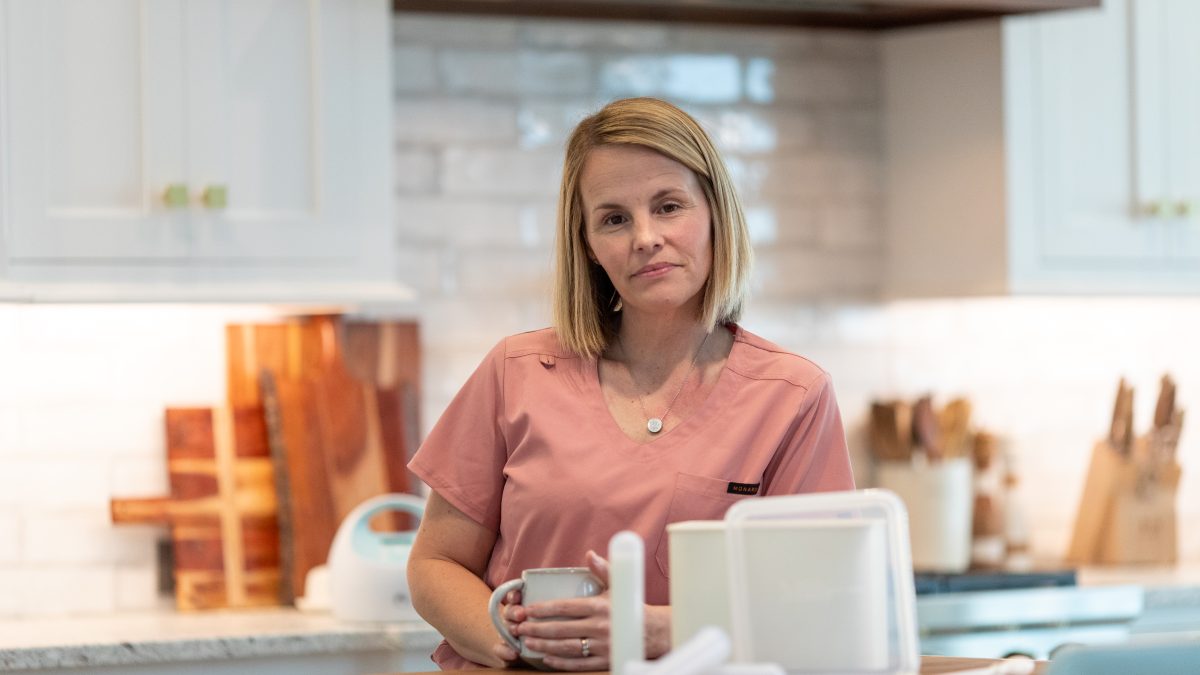
After Years as a NICU Nurse, She’s Rethinking Breast Milk Storage
Shannon Pratten spent decades caring for mothers and babies. Her experiences led her to launch Milk Drunk Club.
After more than 20 years as a neonatal intensive care unit (NICU) nurse, and over a decade as a lactation consultant, Shannon Pratten knew firsthand how much work goes into feeding a baby breast milk. Yet she saw that one part of the process remained frustrating: Mothers were measuring, labeling, freezing, organizing and thawing their milk, usually relying on disposable plastic storage bags because there simply weren’t many other practical options. Drawing on her clinical expertise and personal experience breastfeeding her three children, the Beaufort, South Carolina, entrepreneur developed Milk Drunk Club, a reusable silicone breast milk storage system designed to simplify the process. Now, she’s turning her years of experience supporting mothers into a business built around making breastfeeding and pumping more manageable.
Here’s our lightly edited Q&A, from The Story Exchange 1,000+ Stories Project.
How is your business different from others in your industry?
I wasn’t trying to make a better version of a disposable breast milk storage bag – I reconsidered the storage system altogether. MilkHaven uses reusable silicone tubes to portion milk in practical amounts, with measurement markings and a dedicated freezer organization system, so mothers can see what they have, use what they need, and avoid relying on single-use plastic bags.
Tell us about your biggest success so far.
Turning an idea in my head into a real product. I had no background in product design, manufacturing, engineering or bringing a physical product to market. I started with a problem I understood deeply and had to learn everything else along the way.
Over the past year, I’ve worked through prototypes, materials, testing, manufacturing, packaging, intellectual property and all of the decisions that come with building a product from scratch, while continuing to work as a nurse and lactation consultant and raising my family.
Seeing our finished products leave the manufacturer this summer was probably the moment it became real. What began as me wondering, “Why isn’t there another option?” is now a product that will be in mothers’ homes. Getting it this far, especially without coming from the product or business world, is the accomplishment I’m most proud of to date.
What is your top challenge and how have you addressed it?
Sales and marketing, particularly because I am introducing a product that requires a little education. Most mothers are familiar with disposable breast milk storage bags, so we are not simply asking them to choose one brand over another. I first have to help them see that there can be a different way to store milk.
I’ve addressed that by building trust and education before the product launch rather than relying solely on traditional advertising. I’ve grown Milk Drunk Club through lactation education and conversations with mothers, developed relationships with breastfeeding professionals and organizations, worked with creators who can demonstrate the product in real life, and begun pursuing partnerships and media opportunities that can introduce our product to new audiences.
Have you experienced any significant personal situations that have affected your business decisions?
Motherhood profoundly shaped both my personal and professional life. I have always built my career around being present for my family. I homeschool while continuing to work clinically, including traveling from South Carolina to California approximately every six weeks for NICU shifts. I have built my company alongside those responsibilities, which has required me to be very intentional about my time and how quickly I grow the business.
Breastfeeding, maternal health and low-tox living can be surprisingly polarizing spaces. As I have introduced a new product and shared the thinking behind it publicly, I have sometimes faced criticism directed at my motives and professional credibility rather than the merits of the product itself. Learning to distinguish constructive criticism from hostility has helped me become more confident in communicating what I believe, supporting it with evidence, and continuing to build without feeling that I need to convince everyone.

How do you find inspiration on your darkest days?
Honestly, sometimes I take a nap. I’ve learned that not every hard day needs to be pushed through. When I need something deeper, I go back to my why. Health has always been one of my greatest priorities, both in the way I have raised my family and throughout my career caring for mothers and babies.
I also think about legacy. I want my children to see that it is never too late to try something completely new, to take an idea seriously, or to build something you believe should exist. On the darkest days, remembering that this is about more than whether one particular day goes well helps me keep going.
And sometimes, after remembering all of that, I still take the nap.
What is your biggest tip for other startup entrepreneurs?
Be prepared for how much you are going to have to learn. I think I assumed I would learn how to start a business. What I actually learned is that starting a business means learning dozens of completely different things, often just enough to make the next good decision.
I wish I had known in the beginning that not knowing how to do something doesn’t mean you aren’t ready. You learn, ask questions, find people who know more than you do, make the best decision you can with the information you have, and keep moving. You don’t have to know the entire path. You just have to be willing to learn the next part of it.
What is your go-to song to get motivated on tough days?
I don’t have just one. I vacillate between really happy, upbeat music when I need to change my mood, and nostalgic 90s music when I need something familiar. Give me Jewel, Matchbox Twenty, or even Salt-N-Pepa and apparently I can still sing every word despite not remembering where I put my phone five minutes ago. Sometimes belting out a song I haven’t heard since 1997 is exactly the reset I need.
Who is your most important role model?
Mothers are my greatest role models. I have watched mothers do extraordinarily difficult things while often believing they are simply doing what needs to be done. I see resilience, resourcefulness, intuition, sacrifice, humor and an incredible ability to adapt when things don’t go according to plan.