

There’s a lot we remember today about midcentury America.
The celebrated sights and sounds. The famous leaders and infamous politicians. And the way that image of the happy homemaker, with her feminine hairdo and fit-and-flare dresses, was our answer to the hardship of World War II and the looming anxieties of the Cold War.
But today, as we see the re-emergence of tradwives, it’s worth remembering something we often forget: The misery of women who were relegated to the home.
“There’s a lot of isolation, there’s a lot of unrest in their spirits and in their souls,” says Kristen Thompson, who wrote her graduate master’s thesis at the University of Massachusetts, Boston, on mid-20th-century housewives. “They had these higher dreams and aspirations, and they’re now living in a society that’s pushing them back.”
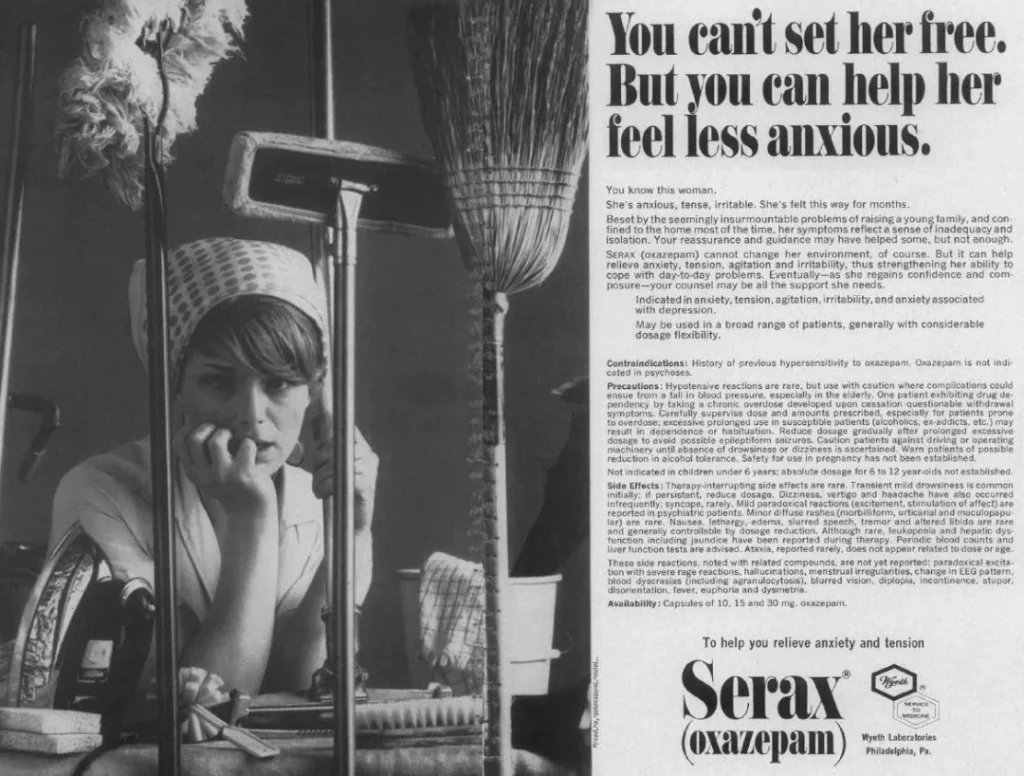
In Episode 2 of our series (listen to Episode 1 here), Thompson tells us about how housewives often turned to tranquilizers, particularly Milltown, which was advertised in popular magazines – Ladies Home Journal, Cosmopolitan, House Beautiful – as a “happy” pill. In reality, Milltown was addictive, dangerous when it came to accidental overdoses, and withdrawal from it could lead to hallucinations and seizures.
We also speak with former tradwife Enitza Templeton, who tells us about the journey she went through – choosing a “traditional” lifestyle and submitting to her husband – but ultimately realizing how unfulfilling it was. “I was just kind of a shell of a human and a robot version of myself,” she says.
Join us for part two of our 3-part podcast series, Invented: The Myth of the American Housewife.
More In This Series
Episode 1
Meet the Cold War-Era Housewife, Complete with Pearls and Aprons
With men back from World War II, working women are thrust back into the home – and become a potent new symbol of American life.
Episode 3
The Forces at Work in Today’s Tradwife Movement – and What Comes Next
Once again, powerful political and religious interests have shaped women’s image. Could a massive transformation be on the way?
COLLEEN: There's a lot we remember today about midcentury America.
VICTORIA: The celebrated sights and sounds...
ED SULLIVAN: Now ladies and gentlemen, yes, that's right: Elvis Presley!
ELVIS PRESLEY: You ain't nothing but a hound dog.
COLLEEN: The famous leaders and infamous politicians.
CBS: Today on the CBS public affairs program Face the Nation, through the eyes of this television camera, Sen. Joseph McCarthy, Republican of Wisconsin...
VICTORIA: And let's not forget about food. Of course, the rise of some iconic American foods: tuna casserole, meatloaf and basically anything made with Jell-O...
MAN: Now, the Jell-O family of famous desserts brings you new Jell-O instant pudding.
COLLEEN: I'm Colleen DeBaise.
VICTORIA: And I'm Victoria Flexner, and this is Invented.
COLLEEN: We're continuing our conversation about the 1950s, and specifically, the birth of the 20th Century American housewife.
VICTORIA: If you missed Episode 1, we spoke with historians like Elaine Tyler May about the very familiar image of the 1950s housewife.
ELAINE: It was glamorized. It was depicted as something fulfilling that women wanted.
COLLEEN: And the way that image of the happy homemaker, with her feminine hairdo and fit-and-flare dresses, was our answer to the hardship of World War II and the looming anxieties of the Cold War.
KRISTEN: It's taking an older concept of traditional gender values and repackaging it in this shiny new bow with aprons and pearls attached to it.
COLLEEN: That's Kristen Thompson.
KRISTEN: I just completed my graduate master's thesis at the University of Massachusetts, Boston.
VICTORIA: The title of Kristen's thesis is: The Homemaker's Guide to Happiness: A Comparison of Methods Used by Dissatisfied Mid-Twentieth Century American Housewives in Their Pursuit of Fulfillment.
COLLEEN: And we wanted to talk to Kristen because we've seen the return of a different type of American housewife...
VICTORIA: The traditional wife, or "tradwife." Here are a few clips from various tradwives on TikTok.
JANEA: I think one obvious thing that makes me a traditional wife is that I submit to my husband, and he is the leader of this household.
ANYA: Trust your husband's judgment. It's your job as a wife to lead your family in the right direction.
JANEA: I give him a warm meal when he comes home, the house is clean, his laundry is done.
COLLEEN: These women are young, cute... they're generally wearing floral sundresses, even when they do completely over-the-top stuff, like chop up organ meat from farm animals.
THE HEALTHY WIFE: As a trad wife, my family's health is my utmost priority. This means that after the cow is slaughtered, we are sure to save its offal, as the organs are actually the most nutrient-dense part of the animal.
VICTORIA: Honestly, when you watch some of these tradwives on TikTok, it's hard to know if this is for real or a joke, because it almost seems like a parody of itself.
COLLEEN: Totally. And it's definitely been mocked on Saturday Night Live. Here's cast member Heidi Gardner playing a trad wife.
HEIDI GARDNER, SNL SKIT: As a 22-year-old mother of 10, I like to do everything by hand. Today my kids wanted to color, but we were all out of paper. So I mashed up my law degree to make more paper for my kids.
COLLEEN & VICTORIA LAUGH
COLLEEN: OK, this would be hilarious, and on SNL it is, if I didn't have young daughters who are scrolling through social media and potentially seeing all these women who seriously talk about being a trad wife like it's... a hot new trend.
VICTORIA: Yes. They're churning butter and wearing puff sleeves... it's this very romanticized version of what a stay-at-home mom and wife should be. It makes me wonder: do they know what life was really like for 1950s housewives?
COLLEEN: I asked Kristen to take us back to the so-called, quote-unquote, "golden age" of America.
VICTORIA: The time period that certain politicians reference when they say they want to Make America Great Again.
COLLEEN: Let's talk a little bit about the reality, and what happened with the housewives of this era. Were they in fact happy?
KRISTEN: So I want to be clear, and kind of put up a little bit of a caveat. Some of them absolutely were, just like now there are absolutely women who do love being in the home, and that's a wonderful thing, and I'm not trying to devalue the work that goes into being a stay-at-home mother and a homemaker. That's incredibly important. However, what we're focusing on, and what I focused on in my paper, are the ones who weren't, and there were a lot who weren't.
COLLEEN: Remember, a few years prior, during World War II, a lot of women were working...
VICTORIA: They were holding down the jobs that men couldn't do, because they were off fighting.
COLLEEN: When the men returned, these women were basically told, for the good of the country, to get out of those jobs and back into the home.
KRISTEN: A lot of them had been working, a lot of them had been educated, so now they've got these degrees, they had these higher dreams and aspirations, and they're now living in a society that's pushing them back, pushing them away from that, and telling them that their greatest dreams of a career are not actually what they want.
1950S COMMERCIAL ANNOUNCER: She's got a man she's promised to love, honor and...
1950S COMMERCIAL ACTRESS: Keep house for the right way!
1950S COMMERCIAL ACTOR: Does that mean I'll never have to deal with the dishes?
1950S COMMERCIAL ACTRESS: Never!
KRISTEN: So for those women who fell into line and became housewives, when maybe at their core they didn't really want to be, there's a lot of isolation, there's a lot of unrest in their spirits and in their souls, because they wanted more, they wanted something different.
COLLEEN: For most housewives, life revolved around cooking and cleaning. There's a podcast out now called the Drowsy Historian about the "horrifyingly boring life" of 1950s housewives.
VICTORIA: This is actually designed to put you to sleep.
DROWSY HISTORIAN: You return to the kitchen, rinse the dishes, dry them one by one, line them neatly in the cabinet. As you wipe the counter for the second time, you notice a tiny streak you missed. You rub it away with the edge of your cloth until the surface shines again.
VICTORIA: Women were expected to not only keep their houses immaculate but also to host polished social gatherings where they could show off their hostessing skills. This is where those Jell-O molds come in, not to mention dishes like shrimp cocktail, pot roast, and honey-glazed ham with pineapple.
KRISTEN: The pressure to maintain the image fell to the woman over and over and over again. And that's even how we see the advent of the cocktail party in the 1950s and '60s, which was a huge symbol of suburbia and "you've made it," sort of thing. So if you could pull off this perfect hosting excursion, this perfect party with the perfect dress and the perfect appetizers, that was a status symbol.
COLLEEN: And if everything wasn't perfect, or if the kids misbehaved, or if the husbands strayed, all eyes were on the women.
KRISTEN: They were blamed for everything. That was all on them because they were a reflection of society. They were a reflection of their husbands, and they needed to be shiny, happy people to kind of prove themselves, improve their families.
DROWSY HISTORIAN: Outside the window, the world hums with purpose. Men driving to work, engines starting, radio singing through open windows. Inside, the silence grows heavier, wrapped in the soft perfume of detergent and routine. You open the cupboard and place each cup in its rightful place.
KRISTEN: And it really led to this really awful mental health epidemic. They were sold this bright, shiny, happy package that they had achieved it, they had achieved the woman's American dream, they had the husband, they had the children, but they were still unhappy because they wanted more. They were looked at as though they were crazy, because what else could you possibly want?
VICTORIA: The writer Betty Friedan famously published a groundbreaking book in 1963 about the frustration of housewives, called The Feminine Mystique. She wrote:
ACTRESS AS BETTY FRIEDAN: "Each suburban wife struggled with it alone. As she made the beds, shopped for groceries, matched slipcover material, ate peanut butter sandwiches with her children, chauffeured Cub Scouts and Brownies, lay beside her husband at night, she was afraid to ask even of herself the silent question: 'Is this all?'"
KRISTEN: So there was really a great sense of shame, and that's why Betty Friedan very famously coined it "the problem that has no name," because it was there, but people weren't talking about it on a large scale. So a lot of the time when they would go see a doctor or go talk to a counselor, they were, A, blamed for the problem themselves. They're like, "So there must be something wrong with you and your mental state for feeling this way."
VICTORIA: Keep in mind, 94% of doctors were men at this time.
COLLEEN: Women's magazines often had advice columns, written by doctors and psychologists, about topics like "Can this marriage be saved?" Kristen included a typical one in her thesis.
KRISTEN: And it's this whole long story about a husband who's a serial cheater, and how over and over and over again, even the psychologist, the trained, licensed physician, was blaming the woman for not keeping the husband happy enough.
VICTORIA: So you've got cooking, cleaning, keeping your husband sexually satisfied, the pressure to make everything perfect, and all the blame if it's not.
COLLEEN: Enter the tranquilizers.
KRISTEN: Okay. Can you see what I'm looking at here?
COLLEEN: I can.
COLLEEN: Kristen showed me vintage advertisements in hugely popular publications of the 1950s and '60s. She ticks off the brands of pills.
KRISTEN: So you see here we've got Quiactin, we've got Miltown, there is Myles-Nervine, there's Butazol, and back to Miltown again.
COLLEEN: Miltown in particular was a blockbuster tranquilizer. The ads Kristen showed me all feature images of housewives in need of medication or on medication.
KRISTEN: If you look at all these ads, they're just blatantly misogynistic. And the only word I have is "ridiculous," because they're like, take these drugs so you're able to thread a needle, so you're able to not burn your muffins, so you're able to deal with your child who is quite literally blocking you in with tension.
COLLEEN: Tranquilizers became the solution for any complaint a woman had, including her husband cheating on her. If she were distressed, she could take a pill, with the hope she could get back quicker to cooking, cleaning and looking perfect.
COLLEEN: Yeah, so this is Johnson & Johnson, Wallace Pharmaceuticals. And are these magazine advertisements?
KRISTEN: They're all pulled from magazines, yes, ma'am. Cosmopolitan, House Beautiful. It's major, major players that were circulated far and wide. This is the entertainment women had for that time period, too. So right next to their articles on how to curl their hair is an advertisement for Butazol and for Miltown. And it's just subliminal messaging, even though it's right in your face.
COLLEEN: Something to point out here: Miltown was initially marketed as safe and side-effect free, a "happy" pill, if you will. In reality, it was anything but. It was highly addictive, dangerous when it came to accidental overdoses, and withdrawal from it could lead to hallucinations and seizures.
KRISTEN: I did my due diligence, I did the research, and absolutely, white middle-class women of the 1950s and '60s were the ones prescribed these drugs more than any other demographic.
COLLEEN: These pills were so prevalent in the 1960s that they became pop-culture references in Hollywood, in books and in music. Here's the Rolling Stones.
MICK: She goes running for the shelter of a mother's little helper.
KRISTEN: And that's where we get the whole phrase "mommy's little helper," because that was mommy's little helper to get them through the day. But obviously it didn't fix the problem. It just numbed their feelings about it.
COLLEEN: Miltown became one of the most popular prescription drugs in U.S. history. It's estimated that by 1965, physicians and psychiatrists had written 500 million prescriptions for Miltown. The numbers eventually dropped as a result of a number of things, from the drug being reclassified in 1970 as a controlled substance to better treatment for mental health issues.
VICTORIA: And yet, here we are, 75 years later, with the lifestyle being glorified on social media.
COLLEEN: I asked Kristen if today's tradwives, or even just women in general, are aware of everything that housewives in the '50s and '60s went through.
KRISTEN: I want to say by and large, no, at least obviously not to the extent I am, because I've dedicated a lot of time to this. I think it's the same thing that did happen in the 1950s. It's this rose-colored nostalgia for a past that was never actually as shiny as it's being marketed as. And I think it's just history repeating itself, or at least patterns repeating themselves. Unfortunately, I don't think they know quite how serious it was, and quite how serious the problems these women faced became, and the drug epidemic, the drug addiction, the alcoholism, the isolation that was all a part of it.
VICTORIA: Much of what the 1950s housewives endured eventually gave way to the rise of second-wave feminism, and then third-wave feminism. Though there have been fractures within the feminist movement in recent years, especially as women of different backgrounds struggle to feel like the movement still represents them...
COLLEEN: And in terms of what happened to the 1950s housewives, many of those connections we had to the past, the mothers and grandmothers who can warn us about it, are gone. And while there is research on this time period in American history...
KRISTEN: I just don't think people are reaching for it. And people kind of joke about it a little bit, especially now, as we are seeing certain rights be kind of rolled back, especially in the aftermath of the repeal of Roe v. Wade. There's a lot of women who are even not part of the trad wife aesthetic who are making jokes such as, "Oh my gosh, if you're going to take away my rights and push me back to the house, at least give me the Quaaludes back, at least give me the drugs back." I understand for a lot of people, it's not that deep, they're not serious, and they are truly joking, but it really just downplays the true struggles these women went through and how serious these crises were, like the mental health, the addiction, all of it. So I don't think it helps.
COLLEEN: When we come back, we'll talk to a former tradwife about what happens when you dream for a past that never really existed.
VICTORIA: Enitza Templeton tells us about her 10-year marriage and the dangers of the tradwife lifestyle.
ENITZA: And I just kept thinking, I remember thinking, I'm not mom enough. Like, I need more kids.
COLLEEN: We'll be right back.
COLLEEN: In January 2024, Enitza Templeton posted a video of herself on TikTok. You're listening to it now. And this is NOT a video with soft lighting and sourdough. She's just sitting there, looking forlorn, in a dingy-looking office building.
VICTORIA: The text on it reads: "Imagine this: The trad wife life didn't work out. You have a 10-year gap in your resume, 4 kids that need to be taken care of while he is off living with another woman, so now you're at the food stamps office trying to see when your application will be approved."
COLLEEN: The video went viral, reaching over 2 million views and racking up comments from many other women who had gone through a similar experience.
ENITZA: It is nice to be a voice. That is kind of my goal with my social media, is to show women my life isn't perfect. I still have problems.
COLLEEN: That is Enitza today. I recently caught up with the former tradwife, who lives in Denver, Colorado. While leaving her marriage was tough...
ENITZA: Nonetheless, I'm happy, and I'm not someone's personal indentured slave stuck in this little prison of home, you know. And being a single mom is not as bad and scary as the world would have you believe.
COLLEEN: Enitza, who is now 43, grew up on the East Coast in a family with traditional values. Her grandmother, originally from Puerto Rico, was a big influence.
ENITZA: I would always say I wanted to be like Betty Crocker, Martha Stewart and June Cleaver all mixed in one.
COLLEEN: From an early age...
ENITZA: I was born into this lifestyle of "you're going to be a traditional wife, you're going to find a man."
COLLEEN: And she did, getting married at 26.
ENITZA: He was our provider, and I did not worry my pretty little head about any of that stuff. And I took care of the kids and the house, and it got so old so fast.
COLLEEN: Not long after their first daughter was born, Enitza remembers...
ENITZA: Not feeling that fulfillment, feeling really tired and scared and confused, you know, all the things you feel when you have a baby. And I was like, "Oh, okay. Maybe the fulfillment comes later." And then we had another child.
COLLEEN: Soon she had 4 kids, actually.
ENITZA: And so, you know, instead of rethinking it, I pushed deeper into it and, you know, "Let's have more kids, more kids," cloth diapering, all their baby food, everything.
COLLEEN: Life consisted of breastfeeding, being pregnant, cleaning, making her own bread, cooking everything from scratch, straightening her hair, putting on makeup and nice dresses.
ENITZA: And then one day, after my fourth was born, I was folding laundry and finally admitted to myself, like, I hate this. This is it. I have children and laundry and cooking, and then children and laundry and cooking, and then children. And I was like, I can't do this. I literally can't.
VICTORIA: Exactly what Betty Friedan described when she said "the problem that has no name."
COLLEEN: Yes. And I should explain here, too, that part of why it took Enitza so long to have this epiphany is that she also belonged to an evangelical Christian church. She and her husband's social circle were mostly other couples who belonged to the church, too.
VICTORIA: Trad wives do tend to be linked to conservative Christian churches, of all sorts.
ENITZA: All of our friends were exactly the same. Our families knew each other. And so we were all, you know, living this same life, living by these same guidelines.
COLLEEN: At church, she was told that being in the home, as a wife and mother, was her only true calling.
ENITZA: A lot of the talking points to encourage women to become a traditional wife are that "this is what you were made to do." This is "your body was designed to carry children and to birth them." Obviously this is what you were meant to do, and this is the only way you find happiness.
VICTORIA: These "talking points" that Enitza mentions are also espoused by conservative groups, from Turning Point to the Heritage Foundation. Here's a clip from a Turning Point conference. This is the late Charlie Kirk speaking at the Young Women's Leadership Summit.
CHARLIE KIRK: Every single one of you have what it takes to be a talented person in office or in corporate life. Most importantly, please become a wife and start a family. That is the most important thing, if you so feel called and want to be happy.
COLLEEN: Something that gnawed away at Enitza was watching everybody else's life... watching her kids.
ENITZA: Study things and learn musical instruments and go to their little, you know, outdoor education day and hiking and all. And I get to clean up the mess after. That's it. That's all I get. I get the crumbs and the scraps. There's nothing for me to do. It's just sit and watch. And I hated that.
COLLEEN: Enitza shares much of her story on social media to help other women. Here's a TikTok she made about how she was able to leave her then-husband.
ENITZA (TikTok): Honestly, I started going to therapy. He was tired of how horrible my sex drive had declined after all the children, and everything was all my fault.
COLLEEN: She thought maybe something was wrong with her hormone levels.
ENITZA (TikTok): I was just kind of a shell of a human and a robot version of myself...
COLLEEN: At first she saw a medical doctor who prescribed her an antidepressant.
VICTORIA: Again, echoes of what commonly happened to housewives in the 1950s and '60s.
COLLEEN: Definitely.
ENITZA (TikTok): And I thought, OK, yeah, maybe the problem is me. I'll go to therapy.
COLLEEN: Fortunately, the therapist that Enitza saw asked a lot of questions about her marriage, her life.
ENITZA (TikTok): She just started to make a bunch of things pieced together. And going through the motions of putting myself first and making sure that I was taking care of myself made it impossible to stay. It wasn't even a question.
COLLEEN: Like a lot of stay-at-home moms, then and now, Enitza didn't have a job, didn't have training, didn't have resources of her own.
ENITZA: I was really scared to leave. And so I thought, maybe if I get a job, like a decent job, you know, like a professional-type job, maybe that will alleviate some of the tension in our marriage and maybe I don't have to get a divorce. So I got permission from my husband to take a certified nursing assistant class, because it was only like six weeks.
VICTORIA: "Got permission" from her husband.
COLLEEN: I know, that says a lot about the relationship. So... Enitza finished the course and actually landed a job.
ENITZA: And it was funny, because as soon as I started making money, I was like, "Oh, I can leave." And I got a little confident. I was like, wait a minute. I do make enough money to... oh my God, I don't need this. A month later we got into an argument, and I finally had the nerve to say, "We're done. We're done, done, officially done. Never doing this again. Goodbye."
COLLEEN: A disturbing study just came out from the University of Nevada, Las Vegas, which reveals that men who are drawn to tradwives are more likely to perceive women through a negative lens.
VICTORIA: Researchers had expected the men to be paternalistic or protective. Instead, they found the men to be hostile and resentful. I'll read from the study's findings: "Men's favorability toward the #tradwife movement is founded on patronizing and derogatory forms of sexism that are harmful to women."
COLLEEN: So I wanted to ask if, either in your own experience personally or from what you know of trad wives, does this make sense?
ENITZA: To women who are saying that they want to be a trad wife and they're saying, "Well, I'm looking for a provider man," I'm like, any man who sees traditional gender roles as appealing clearly has control issues. They want to have total power, and they don't want to love you. They want what you can give them. There's nothing in it for the woman. The propaganda to pull women into the trad wife life is total lies just to serve the man. And yeah, it only serves men that are extremely misogynistic, because how do you look at a loving relationship where you want to build a family, but you basically want nothing to do with the children, because that's the lifestyle? Mom takes care of the kids. Dad does the work. There is no chivalry. It is the meanest of men.
COLLEEN: And Enitza, who throughout our conversation took responsibility for certain decisions she made in her life, had something to say about tradwives, too.
ENITZA: So I think that study would be interesting if they also studied the women that are drawn to the trad way of life, because I think all those qualities exist in the woman as well. You have to have a lot of internalized misogyny and a lot of hate for yourself, or maybe not hate, but you definitely have no love for yourself, to think, "My life is meaningless. I will just give it in service to other people."
VICTORIA: Yet it all looks so pretty on social media.
COLLEEN: I know. Although, as we all know, Instagram and TikTok and YouTube are only showing us the highlight reels of someone's life.
ENITZA: When you look at the big names like Nara Smith, Ballerina Farm, the big, big ones, they do. They look so charming.
HANNAH: Welcome to the Ballerina Farm kitchen. Today we are making sourdough bread...
ENITZA: And it's funny, because when I watch their content and I know what it feels like on the inside, it's funny to see the look on their faces and the deadness behind their eyes as they're like, "And I'm making this bread," and you can see it. I remember what that was like. And I'm like, I'm not falling for it. I can see it.
COLLEEN: We know what happened to the 1950s housewives. There was a lot of hitting rock bottom, the addictions, the alcoholism. I know this is sort of like looking into a crystal ball, but with the trad wives, what do you think rock bottom will look like this time around?
ENITZA: Mm. I think it's the same thing. Look at how women now are being prescribed, you know, Xanax. You see a lot of women talking about their alcoholism and the way that they struggle, because we can't just go and get barbiturates from the doctor. So women are turning to things that they can. There's a big rise in moms that smoke weed. So I do think the rock bottom is still the same, and it is still, you know, solved with substances, just different substances.
VICTORIA: Well, it sounds like Enitza is in a better place now.
COLLEEN: Very much so. She does a lot of advocacy work and public speaking about what happened to her, and works in home health care for her day job. But she did lose a lot of friends at first, especially the fellow trad wives at her church.
COLLEEN: Are you still in touch with any of them?
ENITZA: Oh, no. I was a sinner, but you might as well have had a big red A across my chest, because I broke my covenant with the Lord. I broke my covenant with my husband. I broke my covenant of friendship and sisterhood with all my Christian sisters.
COLLEEN: She also had a strained relationship with her family for a while.
ENITZA: Even my mom, even my parents: "What are you going to do? Oh my God. But you have four kids. Oh my God. Oh my God." And I had to cut them off for a little bit, too. There's no way I'm going to move forward if everybody's telling me I can't do it. But yeah, you rebuild, you find new friends, you find a new life, you find new everything.
VICTORIA: As we get to the end of this episode, we talked a lot in Episode 1 about how American housewives in the 1950s were perhaps unwittingly part of a larger political strategy to prop American life up, promote capitalism and make the nation appear superior to Communist society. What's the political strategy now?
COLLEEN: It's a good question. Traditional gender roles, for quite some time now, have been a huge focus of conservatives in general, but the alt-right in particular. And unfortunately, things that used to seem "fringe" are now rapidly rising up and becoming normalized.
COLLEEN: Why are we seeing a resurgence of this traditional housewifery? Why now? What's it driven by?
ENITZA: You know, I think every new generation thinks they know all the solutions to the world's problems. And they think this is the solution: if women are submissive to men, the whole world would function perfectly. Women just need to know their place.
COLLEEN: And not to end this episode on a cliffhanger, but Enitza told me how in many trad wife circles, there is a firm belief in the head-of-household voting system.
VICTORIA: That's a belief, mostly based in biblical patriarchy, that the man of the house holds all the authority, and that it's even unnatural for a woman to vote.
ENITZA: I would say this when I was a trad wife: my husband should be able to vote. He should have six votes: one for him, one for me and one for each of our four children. So when my husband goes to the polls, his vote should count for six.
COLLEEN: In the final installment of this series, we'll take a look at what's driving the housewife movement this time around.
VICTORIA: We talk to journalist and author Madeline Peltz.
MADELINE: I've spent the last several years on the ground in the conservative youth movement.
VICTORIA: And she'll tell us about what she's seen at Turning Point conferences and other conservative gatherings...
MADELINE: Even a mother saying that she would be fine with her daughter not having the right to vote, which is really, really disturbing. I think it goes to show how suggestible this audience is.
VICTORIA: We thank Kristen Thompson and Enitza Templeton for spending time with us.
COLLEEN: And we thank you for listening. This has been The Story Exchange. If you like this podcast, please share on social media or post a review wherever you listen. It helps other people find the show. And visit our website at thestoryexchange.org, where you'll find news, videos and tips for entrepreneurial women. Follow us on Facebook, Instagram, LinkedIn, YouTube and Bluesky, and sign up for our free weekly newsletter.
VICTORIA: I'm Victoria Flexner. My co-host is Colleen DeBaise. Sound editing provided by Nusha Balyan. Production coordinator is Noël Flego. Executive producers are Sue Williams and Victoria Wang. Our mixer is Pat Donahue. Recorded at Cutting Room Studios in New York City and Noatune in London.